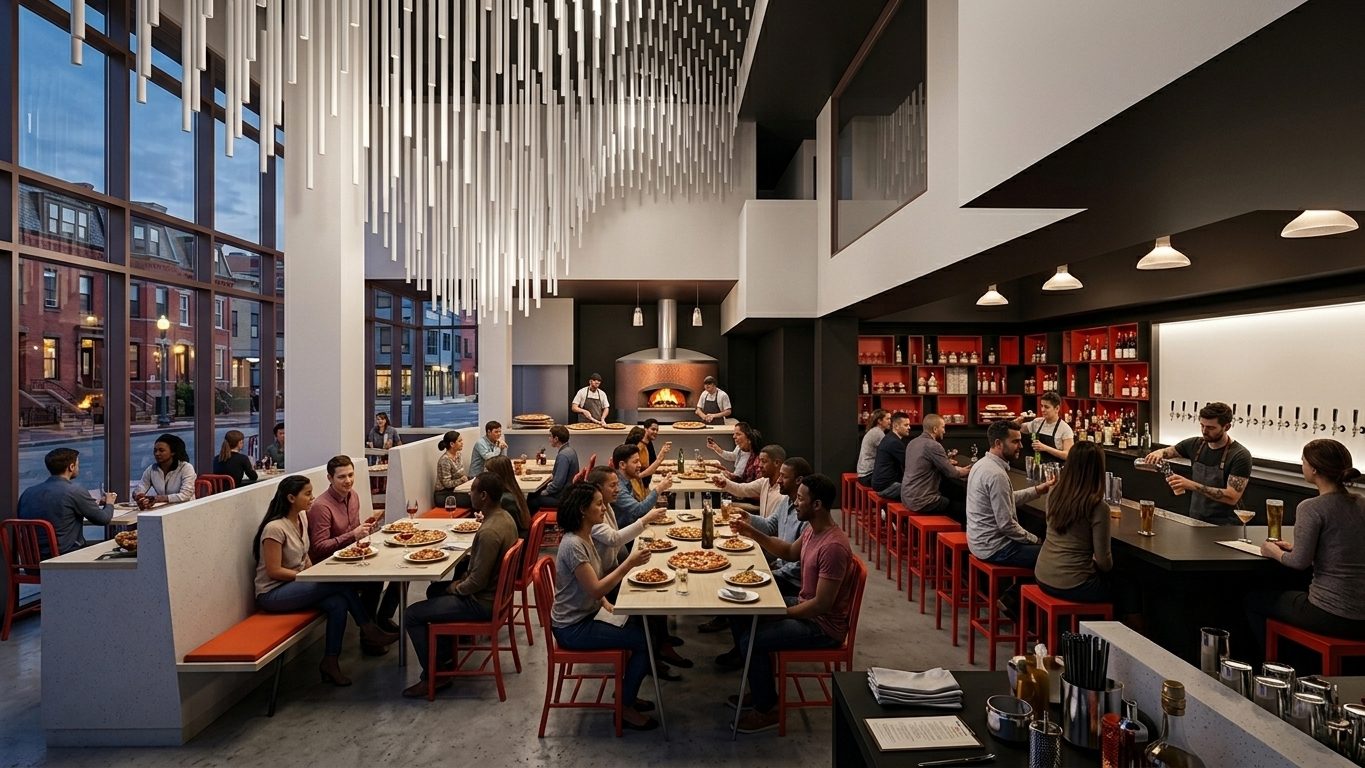
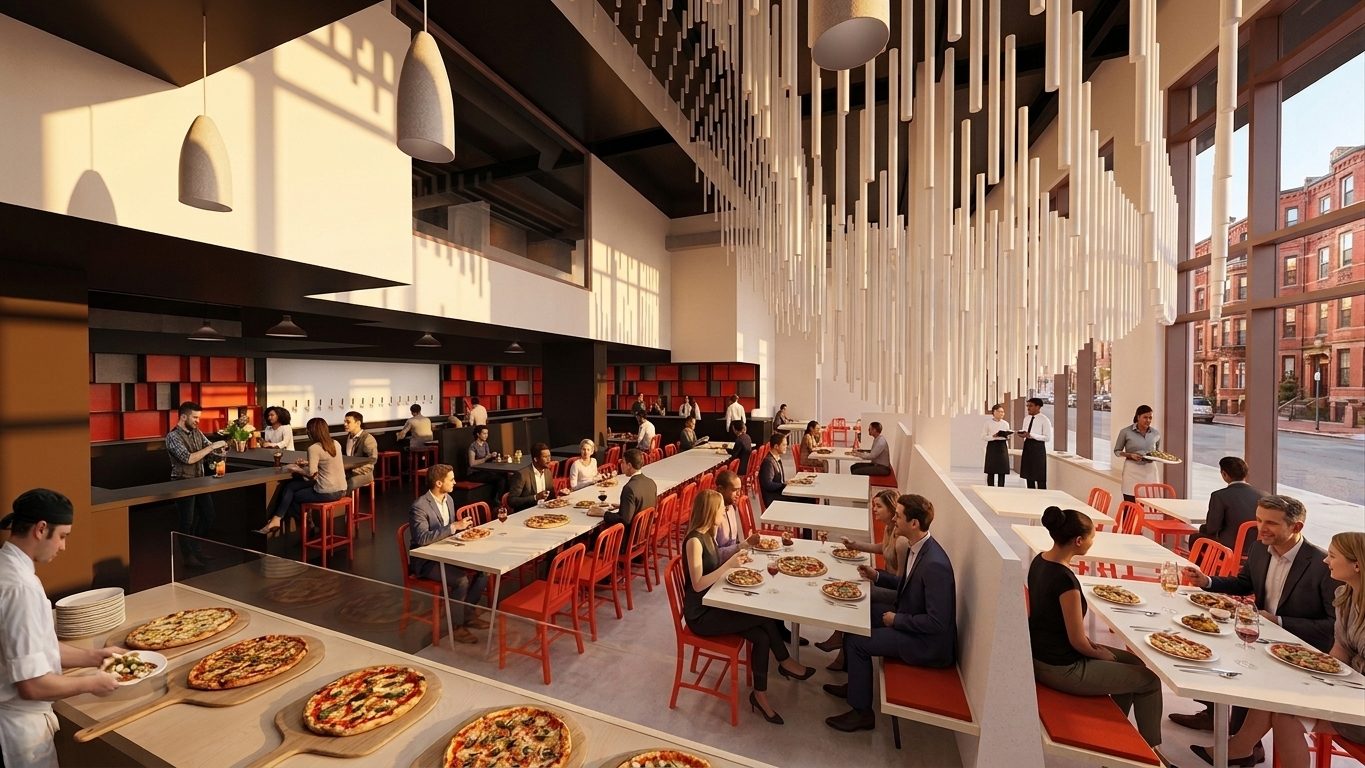
View through the dining hall toward the brand's prominent pizza oven at the rear: a rolling field of white dowels hangs from the double-height ceiling above the long communal table, low banquettes line the left wall with their red-orange seat tops, and the bar zone is visible at right under a lower ceiling with its grid of orange and white blocks behind

South End Restaurant

Boston, Massachusetts

The project is a second outpost for Area 4, the restaurant whose original home in Cambridge had built a following around pizza from a prominent oven and casual communal seating. The clients wanted to carry both of those things forward into a new ground-floor space in a residential tower in Boston’s South End: the same oven as a piece of architecture, the same kind of room around it, with the brand intact at a larger scale.

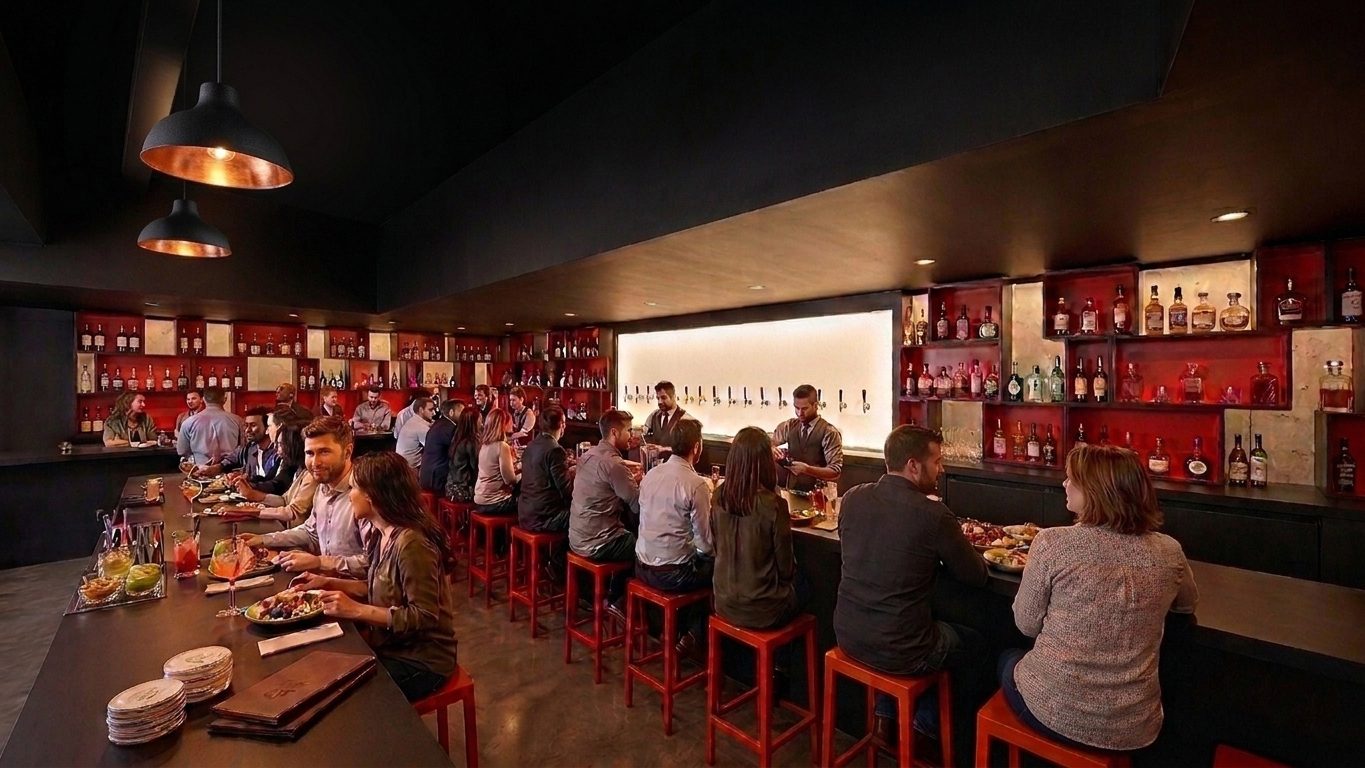
The existing space carried a mezzanine across half of the main level, which left the front half of the room double-height and the back half at a more domestic ceiling. We took the contrast as a given and pushed it further. In the front, where the ceiling rises to the mezzanine soffit, a rolling field of white dowels hangs from above — lower over the banquettes that line the side walls, higher over the long communal table down the middle — so that the volume reads as one room measured by the dowels rather than by the walls. At the rear, where the ceiling drops, the materials turn darker: the bar runs along one wall under a black soffit, the casework around it wraps in a Mondrian-like grid of orange and white panels, and the room registers as a separate bar room sharing the larger one.

The pizza oven sits at the back of the dining space, framed against the lower-ceiling zone so that the chef’s work is visible across the full depth of the room. The communal table and the banquettes give the dining floor its register; the bar gives the back its own. Both rooms are part of the same restaurant and read that way, but the architecture lets the two heights mean different things.
Project Team
Principal
Warren Schwartz, AIA
Project Manager
Michael Schanbacher, AIA
Project Team
John McCampbell
View from the kitchen looking down the length of the restaurant: the rolling field of white dowels above the central communal table, full-height windows on the right wall, red-orange chairs along the long table and the banquettes, and the bar zone at the back under a lower ceiling with the orange-block wall behind
The bar zone under its lower ceiling: a long L-shaped bar counter in dark stone with a row of orange stools along the front, two pendants hanging above, and a continuous wall of orange and white blocks arranged in a Mondrian-like grid behind the bar with a row of beer taps centered on a back-lit white panel
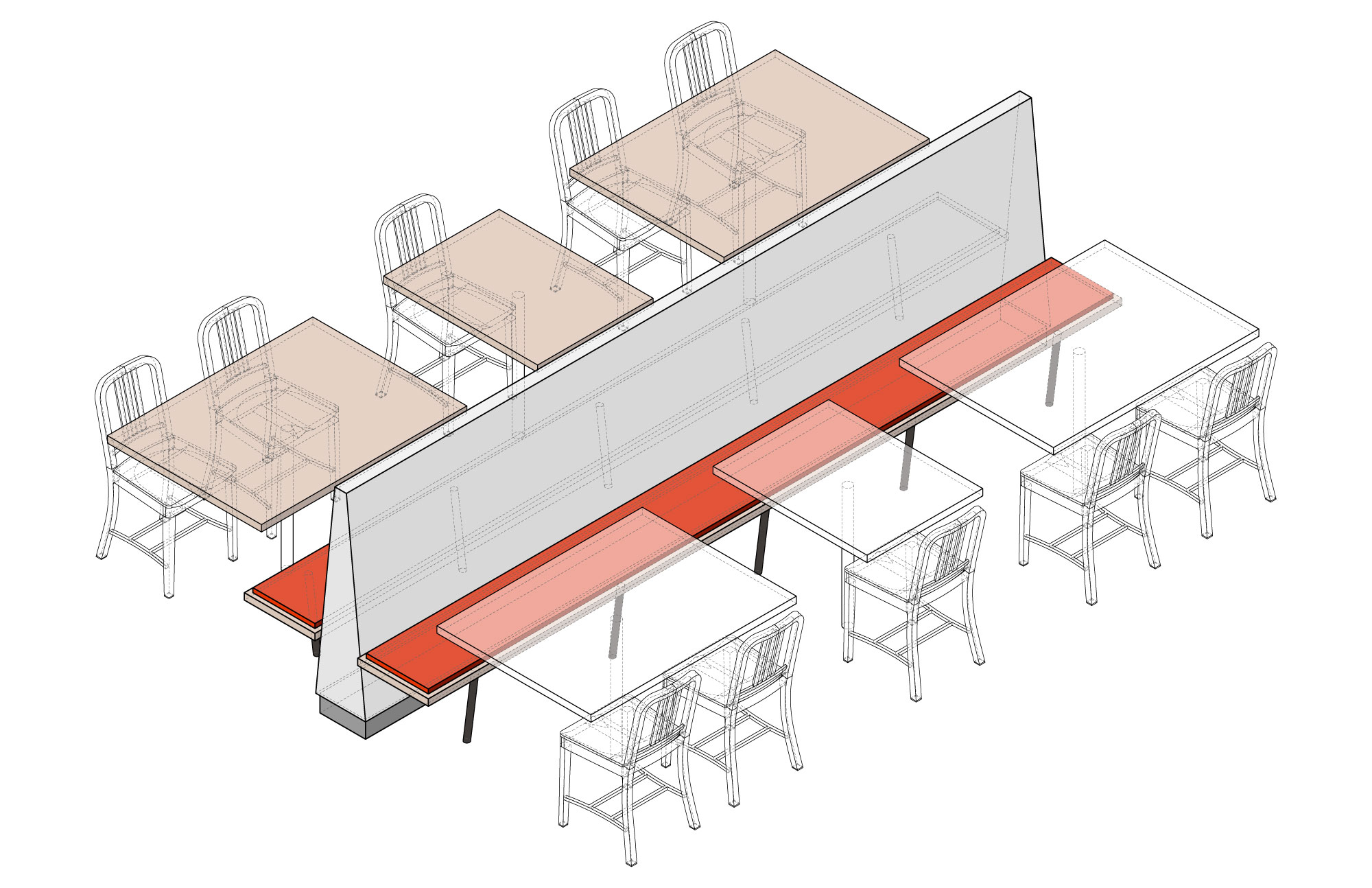
Isometric of a back-to-back banquette element in the dining hall: a low bench with red-orange seat tops running along both sides of a vertical white divider, dining tables and red-orange chairs ghosted in line on each side, drawing the unit that organizes the side aisles of the room
Banquette
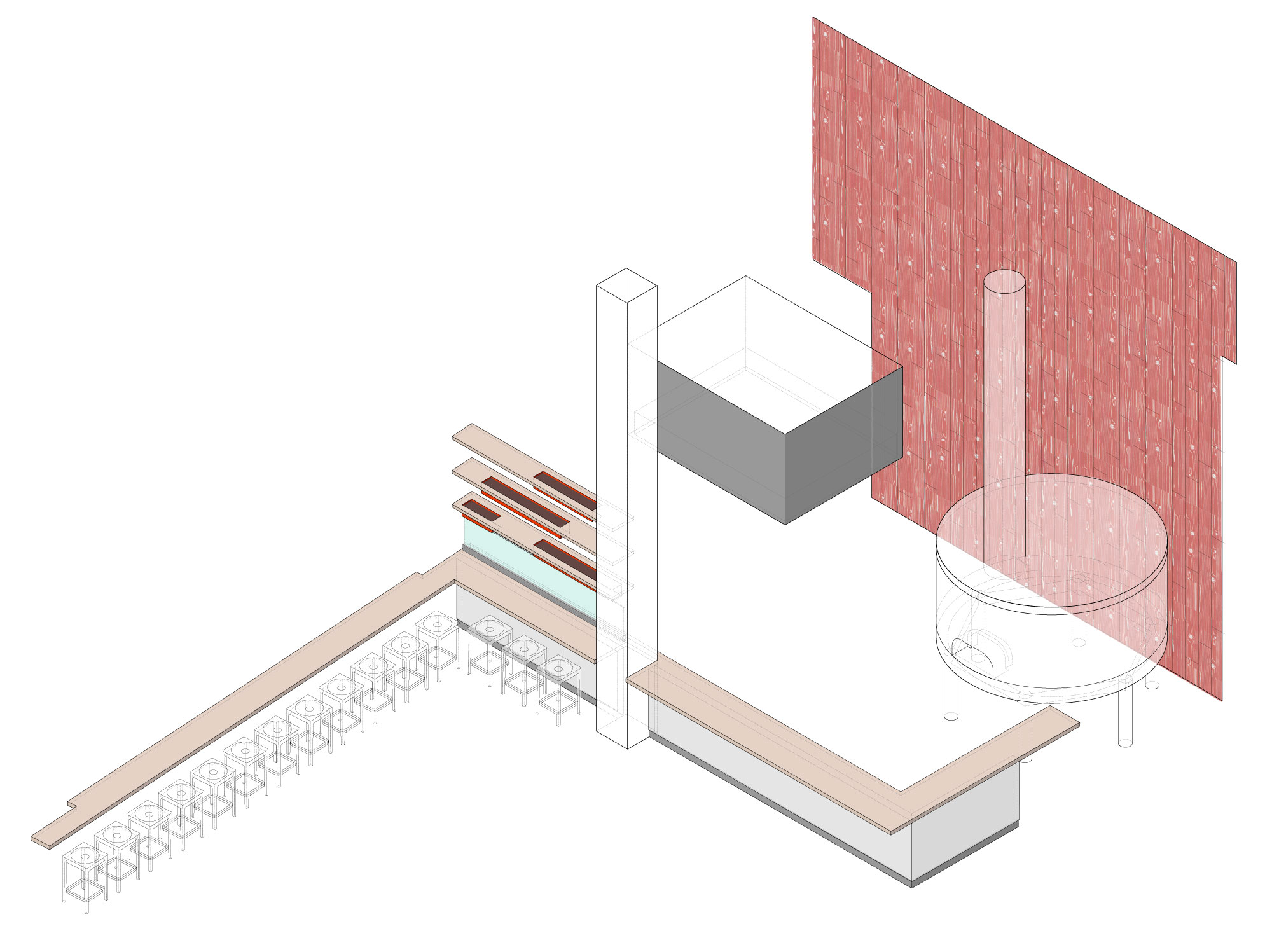
Isometric of the kitchen pass at the pizza oven: the cylindrical wood-fired oven with its exhaust stack rising against a red-brick wall at right, a stainless hood above, and the counter and rail running off to the left with a row of bar stools along the pass
Kitchen Pass
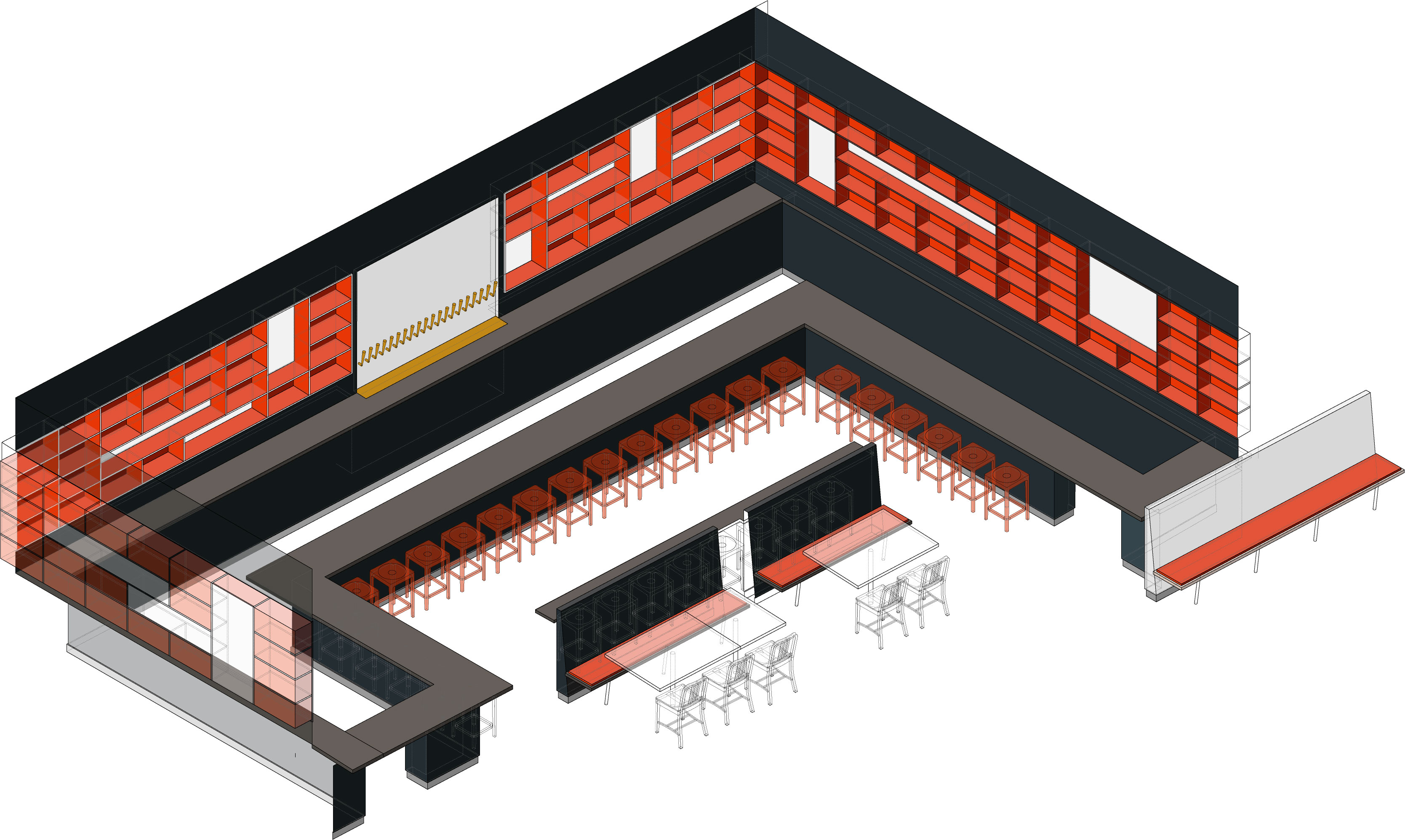
Isometric of the full bar zone: the L-shaped bar counter wrapping a corner with a continuous row of orange stools along the front, the wall behind drawn as a deep grid of orange and white panels acting as both shelving and graphic surface, a beer tap row on a white panel at the inside corner, and the dining tables and banquettes at the foreground in the larger room
Bar
Archive
Further work